What jury selection software replaces
In most prosecutor's offices, jury selection still runs on paper. A legal pad with a hand-drawn jury seating chart. A separate sheet for strikes. A second legal pad for voir dire notes. Maybe a spreadsheet someone built years ago that nobody updates.
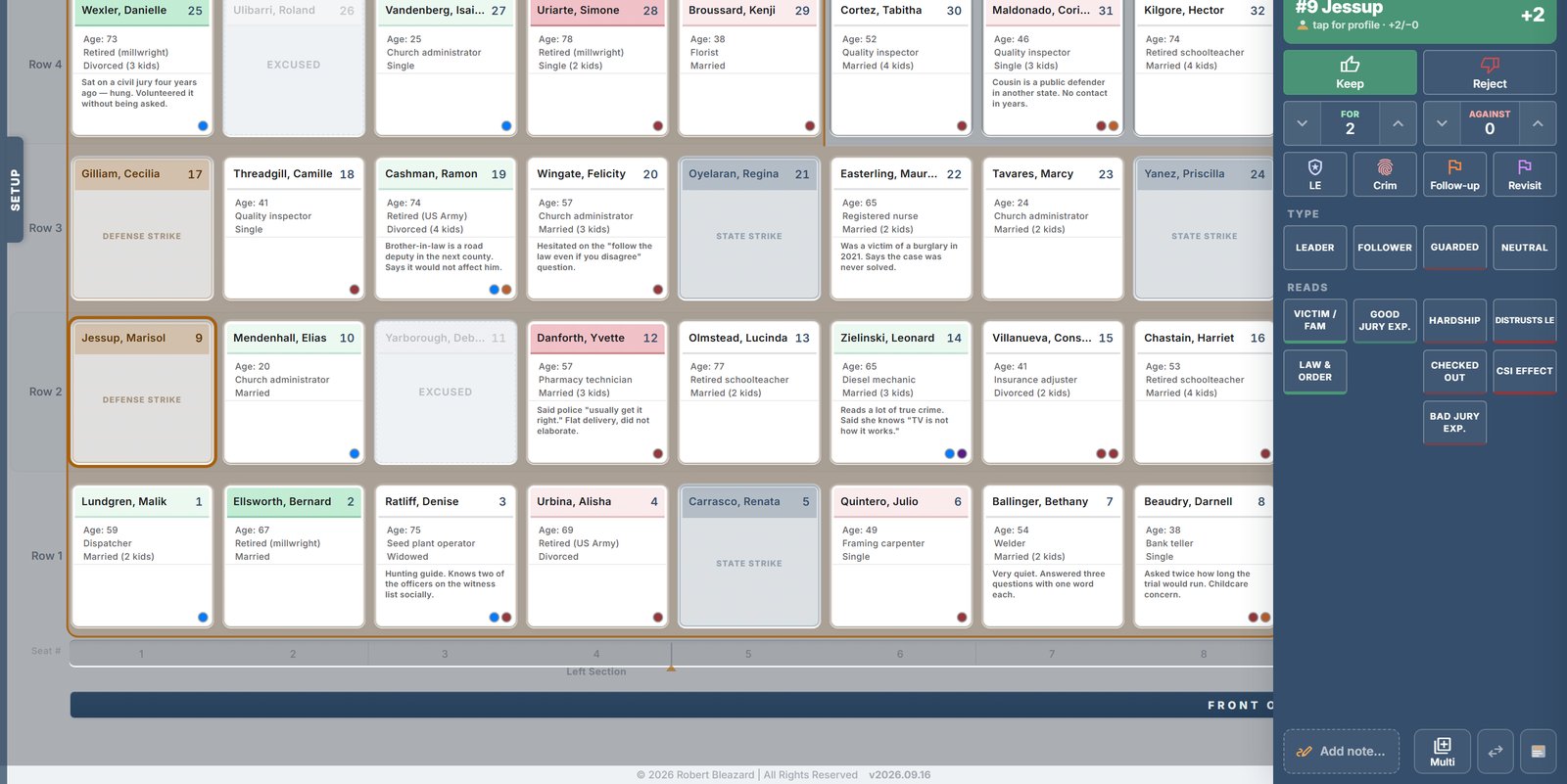
Jury selection software replaces all of it with a single shared workspace — the juror list, the seating chart, the strike tracker, the notes — visible to everyone on your trial team at the same time. When a juror is struck, everyone sees it. When a note is added, everyone has it. No passing paper. No whispering across the table.
The digital jury seating chart
The core of any jury selection app is the seating chart. A good one mirrors the courtroom — not a generic grid, but the actual layout your jurisdiction uses: how many seats in the box, where alternates sit, which seats fill first.
A digital jury seating chart shows you what paper can't: who's flagged, who's rated, who has a criminal history flag or a law enforcement connection — all visible at a glance while the judge is calling names. When a juror is struck and the next one fills the seat, the chart updates for the entire team instantly.
In strike-panel jurisdictions, the seating chart also shows the strike zone — which jurors are within range of your remaining peremptory strikes and which are out of reach. That's a calculation most prosecutors do in their head. Software does it automatically.
Strike tracking that doesn't break
Losing count of your peremptory strikes mid-voir dire is the kind of mistake that doesn't surface until it's too late. Jury selection software tracks cause strikes, peremptory strikes, hardship excuses, and failures to appear in real time. State strikes and defense strikes are tallied separately. The count is always visible.
For offices that use a struck-jury system, the software tracks pass rounds too — who's been passed, whose turn it is, how many remain. No ambiguity. No mental math.
Real-time collaboration during voir dire
Most jury selection tools are single-user. That's a problem for any trial team with more than one person at the table. Real-time voir dire collaboration means the lead prosecutor, second chair, and the paralegal or analyst are all working the same panel — on their own devices — at the same time.
One person flags a juror during questioning. Another adds a note from the questionnaire. A third updates a rating. Everyone sees every change as it happens. When the judge calls a recess and you have four minutes to decide your next strike, the information is already in front of you.
Importing the juror list
Every jurisdiction sends the juror list differently — some as a PDF, some as a CSV, some as a printout you have to work with. Jury selection software should handle the format your court sends without forcing you to reformat it. Upload the file, and the software parses names, addresses, occupations, and demographics into individual juror profiles.
That import is where the preparation starts. Work through profiles before trial — rate jurors, flag concerns, draft questions — and everything you build carries into the courtroom when voir dire begins.
What to look for
Built for your side of the courtroom. General litigation tools try to serve everyone — prosecution, defense, civil. A jury selection app built for prosecutors understands prosecution-specific needs: law enforcement connection flags, criminal history indicators, the way a juror cuts for the State.
Priced for government budgets. Most legal technology is priced for private firms billing $400 an hour. Prosecutor's offices operate on county budgets. If the per attorney cost requires a budget line item your office doesn't have, the software doesn't matter.
Works without IT infrastructure. Prosecutor's offices don't have dedicated IT departments evaluating software. A jury selection app should run in a browser on any device — no installs, no app store, no IT ticket.
Real-time, not file-based. If two people can't work the same panel at the same time, you're just using a shared spreadsheet with a better UI. Real-time sync is the difference between a tool and a toy.
JuryPanel was built by a working trial prosecutor for exactly this use case — a jury selection app purpose-built for prosecutor's offices, with a digital jury seating chart, real-time strike tracking, voir dire collaboration, and office-wide pricing that fits a government budget.
Request a demo and see it work.
Related guides
Voir Dire Checklist for Prosecutors — What to prepare, what to track in the courtroom, and what to preserve after.
How to Track Jury Strikes — Why paper strike sheets break down and what real-time strike tracking looks like.
Jury Selection App vs. Legal Pad — A side-by-side comparison of paper and digital jury selection workflows.