Before trial: panel preparation
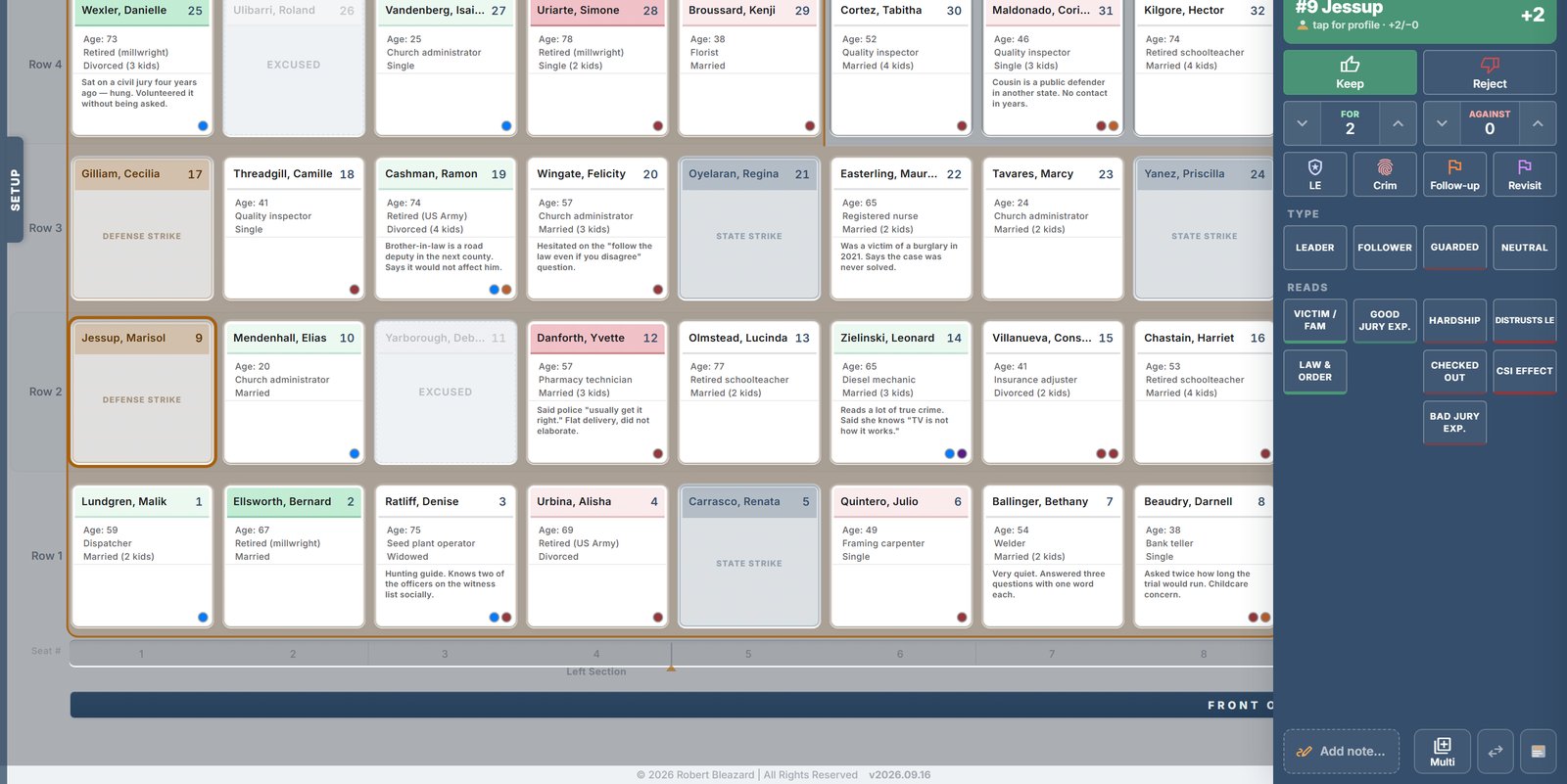
Import the juror list as soon as it arrives. Whether your court sends a PDF, CSV, or printed roster, get the names into a system you can work from — not a legal pad you'll have to recreate the morning of trial. Parse names, addresses, occupations, and any demographics the court provides into individual juror profiles.
Work through every juror before you walk in. Rate jurors on a scale. Flag law enforcement connections. Flag criminal history concerns. Note anything from social media or public records that informs your questioning. Draft juror-specific questions you want to ask during voir dire. The goal is to walk into the courtroom with a position on every juror — not to form one on the fly.
Know your strike math. How many peremptory strikes does each side get? How many alternates? What's the total panel size? If your jurisdiction uses a strike-panel system, know the strike zone — which jurors are within reach and which aren't. This math should be settled before voir dire starts, not calculated during.
Courtroom setup
Map the seating chart to the actual courtroom. Know how many seats are in the jury box, where alternates sit, which direction seats fill. If your courthouse has multiple courtrooms with different layouts, have the right configuration ready before the panel walks in.
Coordinate with your trial team. If you have co-counsel, a paralegal, or an analyst, everyone should be looking at the same panel — same juror profiles, same flags, same notes. Decide in advance who's tracking what: who's taking notes during questioning, who's updating ratings, who's watching the defense.
Have your voir dire outline ready. Not a script — an outline. The themes you want to explore, the commitments you need from the panel, the questions that expose bias. Keep it accessible during questioning so you can adapt without losing the structure.
During voir dire: what to track
Update juror ratings in real time. First impressions change. A juror who looked good on paper may give an answer that moves them from favorable to unfavorable. Capture that shift when it happens, not during the recess when you're trying to remember what twelve different people said.
Flag follow-up jurors. When a juror says something that needs a deeper question — but the judge is moving on — mark them for follow-up. Don't trust yourself to remember. The pace of voir dire doesn't reward memory.
Track cause challenges as they happen. When a juror is excused for cause, hardship, or failure to appear, record it immediately. These affect the strike math for every remaining decision. If your team doesn't have a shared, current count of remaining peremptory strikes, you're guessing.
Watch the panel composition shift. As jurors are struck and replaced, the overall composition of the jury changes. Demographics, occupations, flags — keep an eye on the big picture, not just the individual seat you're deciding on right now.
Strike decisions
Don't burn strikes early on jurors who might get struck for cause. If opposing counsel is likely to challenge a juror, let them. Save your peremptory strikes for the jurors only you can remove.
Know what you're left with after each strike. Every peremptory strike changes the equation. Before you strike a juror, know who fills that seat next — and whether the replacement is better or worse. In strike-panel jurisdictions, this means understanding the full order of the panel, not just the current box.
Document the reason for every strike. Batson challenges happen. When they do, you need an articulable, race-neutral reason for every peremptory strike — and you need it immediately, not reconstructed from memory after the fact. Record your reasoning as you go.
After selection: preserve the record
Export the full panel record. Seat layout, strike summary, juror notes, alternates, the complete picture of how the jury was selected. This goes in the trial file. If there's an appeal, you'll want the contemporaneous record — not a reconstruction.
Save your voir dire strategy notes separately. The questions you asked, the themes that worked, the juror responses that surprised you. These don't go in the official record, but they make you better the next time you pick a jury.
What this comes down to
The difference between a smooth voir dire and a scrambled one is usually preparation and information flow — not courtroom instinct. The prosecutors who pick the best juries aren't the ones with the best gut feel. They're the ones who walked in with a position on every juror, tracked every change as it happened, and never lost count of their strikes.
Most of that is process. And most of that process is easier with jury selection software built for the way prosecutors actually work.
JuryPanel handles every phase on this checklist — from juror list import and pre-trial preparation through real-time strike tracking and post-selection PDF export. Built by a prosecutor, for prosecutor's offices.
Request a demo and see how it works in your courtroom.