The gap nobody talks about
A new deputy's first jury trial usually comes within months of being sworn in. They have been trained on charging decisions, plea negotiations, evidentiary foundations. Voir dire, the phase that decides who judges everything else they do, gets a fraction of that attention — typically a sample question list and whatever they absorbed from second-chairing once.
The result is predictable. New deputies script their questions and read them. They form no position on individual jurors because they're too busy managing the next question. They burn peremptories on jurors the defense would have struck anyway, and they walk out unable to say why the panel ended up the way it did.
None of this is a talent problem. It's a method problem, and method can be taught.
What experienced prosecutors do differently
Watch a fifteen-year prosecutor pick a jury and the difference isn't charisma. It's that the invisible work is already done. They walked in with a position on every juror the court's list could support. They track how each answer moves a juror up or down. They know the strike math cold — how many peremptories remain on each side, who enters the box next, whether the replacement is better or worse than the juror they're considering striking.
Training, at its core, is making that invisible work visible. A new deputy can't imitate instinct, but they can be handed the process that instinct runs on: rate every juror before trial, update the rating when an answer changes it, never strike without knowing who fills the seat.
Build an office method, not forty personal ones
In most offices, every attorney picks juries their own way — their own chart notation, their own shorthand, their own sense of what gets flagged. That works fine until a deputy gets sick mid-trial, a second chair joins late, or a supervisor tries to review what happened.
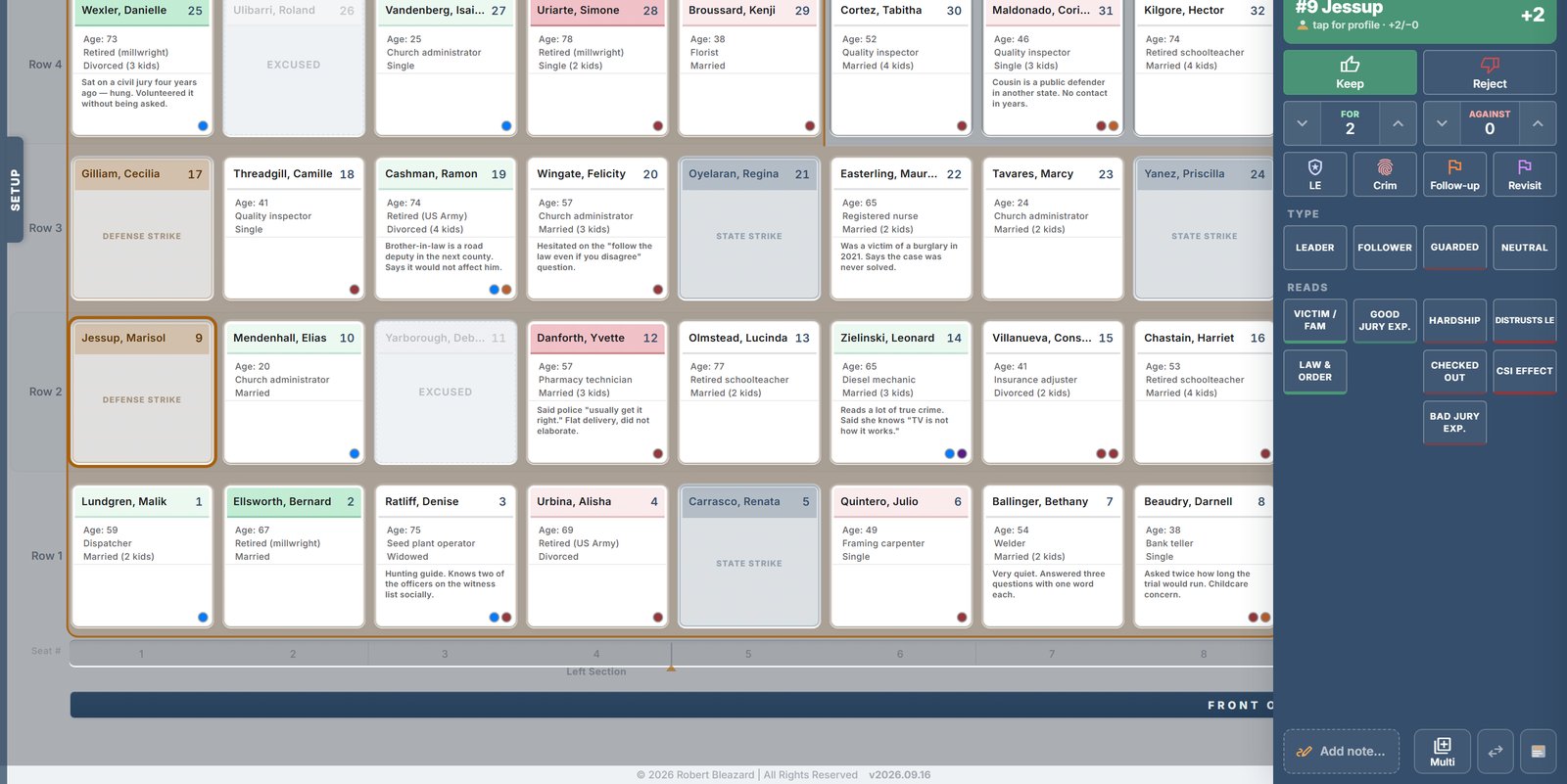
An office method means shared conventions: a common rating scale, so "she's a 2" means the same thing at every counsel table. Standard flags — law enforcement connections, prior jury service, criminal history exposure — applied the same way on every panel. Defined roles when two people sit at the table: who questions, who tracks, who watches the defense. New deputies inherit the method on day one instead of inventing a private system under pressure.
This is also how the office's experience compounds. When the conventions are shared, what the felony team learns about questioning sequence or panel composition transfers to the newest misdemeanor deputy, instead of retiring with whoever learned it.
Supervising voir dire you didn't watch
Supervisors can't sit in on every misdemeanor trial. Most voir dire in a busy office happens with no senior attorney in the room — which means the debrief usually runs on the deputy's own recollection of how it went. That's the least reliable account available.
A reviewable record changes the conversation. If the deputy's panel notes, ratings, strikes, and reasons are captured as they happened, the supervisor can reconstruct the selection: where the strikes went, what was flagged and ignored, whether the peremptories tracked the ratings or contradicted them. The debrief becomes specific — "you struck your 3 and kept a 1, walk me through that" — instead of general encouragement.
The same record is the office's institutional protection. Batson challenges and post-conviction review don't care that the deputy was new.
Volume is the curriculum
Here is the one advantage a prosecutor's office has over every other trial practice: reps. A new deputy on a misdemeanor docket might pick more juries in their first two years than a civil litigator sees in a career. Each one is a complete cycle — prep, selection, verdict, debrief — compressed into days.
An office that treats those reps as a curriculum, with a consistent method and a reviewable record for each one, turns its docket into a training program it's already paying for. An office that doesn't is just hoping experience accumulates on its own. Sometimes it does. The good habits usually don't.
JuryPanel gives a prosecutor's office one system for jury selection — shared ratings and flags, the same seating chart conventions in every courtroom, and a complete exportable record of every panel a deputy picks. New attorneys inherit a method. Supervisors review the record, not the recollection. Built by a prosecutor who trains them.
Request a demo and see what an office method looks like.