Same destination, different roads
Every system ends in the same place: twelve jurors and the alternates, sworn. What differs is the order of operations — when jurors are questioned, when challenges are exercised, and most importantly, how much you know about who replaces a struck juror at the moment you strike them.
That last variable is the strategic heart of the whole subject. The systems below are described generally; your jurisdiction's local rules and your judge's preferences control, and the names for these procedures vary more than the procedures themselves.
The strike-panel family
A panel larger than the final jury is seated and questioned in a known order — say, the first twenty-six in the box and rows behind it. Both sides question the full panel, cause challenges are resolved, and then peremptories are exercised against the ordered list. The jurors who survive, in order, become the jury.
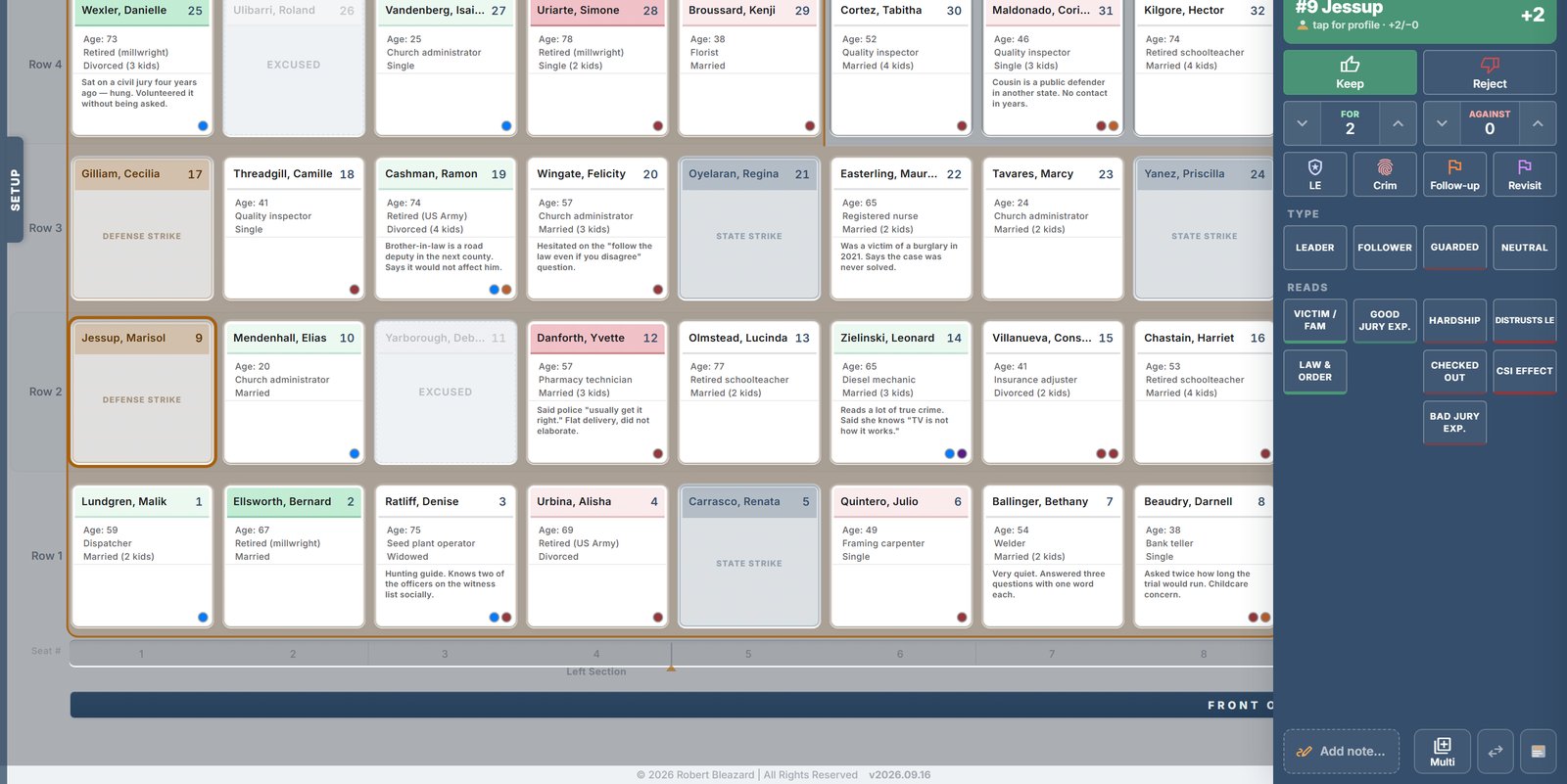
The defining feature: the replacement order is visible the whole time. You know that if juror 7 goes, juror 13 steps into the twelve. This creates the strike zone — the range of panel positions that can actually reach the box given the strikes remaining on both sides. A juror beyond the zone can't be reached no matter what you do, and a peremptory spent on them is a peremptory wasted.
Strike zone math is the discipline of this system: every strike — yours and theirs — moves the zone's edge, and the calculation has to be redone each time. It's exactly the kind of running arithmetic that's hardest to do in your head while also questioning a panel.
The struck-jury family
The court first qualifies a full panel: cause challenges, hardships, and excusals are resolved until the pool contains enough qualified jurors to survive all possible peremptories. Then the sides alternate strikes — often in rounds, sometimes against a written list — until twelve remain.
The defining feature: peremptories come after full information. You've heard every qualified juror before you strike anyone, so the decision is comparative across the entire pool rather than sequential. The bookkeeping burden shifts to the rounds themselves — whose turn, who passed, how many strikes each side has left in the round. Passing has tactical weight: a side that passes may bank flexibility or may forfeit it, depending on local rules, and misreading the pass posture is this system's signature unforced error.
The sequential family
(stand‑and‑strike and its cousins)
Jurors are called forward and addressed in smaller groups or one at a time — questioned, challenged for cause, then accepted or struck before the next group is called. The box fills as you go.
The defining feature: you decide with the least information about replacements. Strike the juror in front of you and the replacement is a name on a list you haven't heard speak. Every peremptory is a bet that the unknown replacement is better than the known juror — which makes panel list preparation worth proportionally more here than in any other system. The more you know from the paper before voir dire starts, the less of a gamble each strike becomes.
Why the differences matter strategically
The same instinct produces different correct moves in different systems. Burning an early peremptory on a borderline juror is defensible in a struck-jury round where you can see the whole field; in a sequential system it's a leap of faith; in a strike-panel system it might be flatly unnecessary because the juror sits outside the zone. Knowing your system isn't trivia — it's the frame that tells you what each strike is worth.
It also tells you what your tracking has to do. Strike-panel selection demands live zone math. Struck-jury selection demands round and pass tracking. Sequential selection demands deep pre-trial preparation on the full list. A generic seating grid — the court-provided map, the hand-drawn chart — supports none of these specifically, which is why most attorneys end up doing the system's hardest work in their heads.
JuryPanel renders jury selection the way your jurisdiction actually runs it — strike-panel with a live strike zone, struck-jury with round and pass tracking, sequential systems with the full panel list worked up before you walk in. Configure your courtrooms once and every trial after that starts in the right system.
Request a demo and see your jurisdiction rendered correctly.