Panel preparation
Legal pad: You get the juror list from the court. You print it. You go through it name by name, writing notes in the margin. If you have co-counsel, you each make your own copy. Your notes don't merge. The night before trial, your preparation exists in one place — your handwriting on your paper.
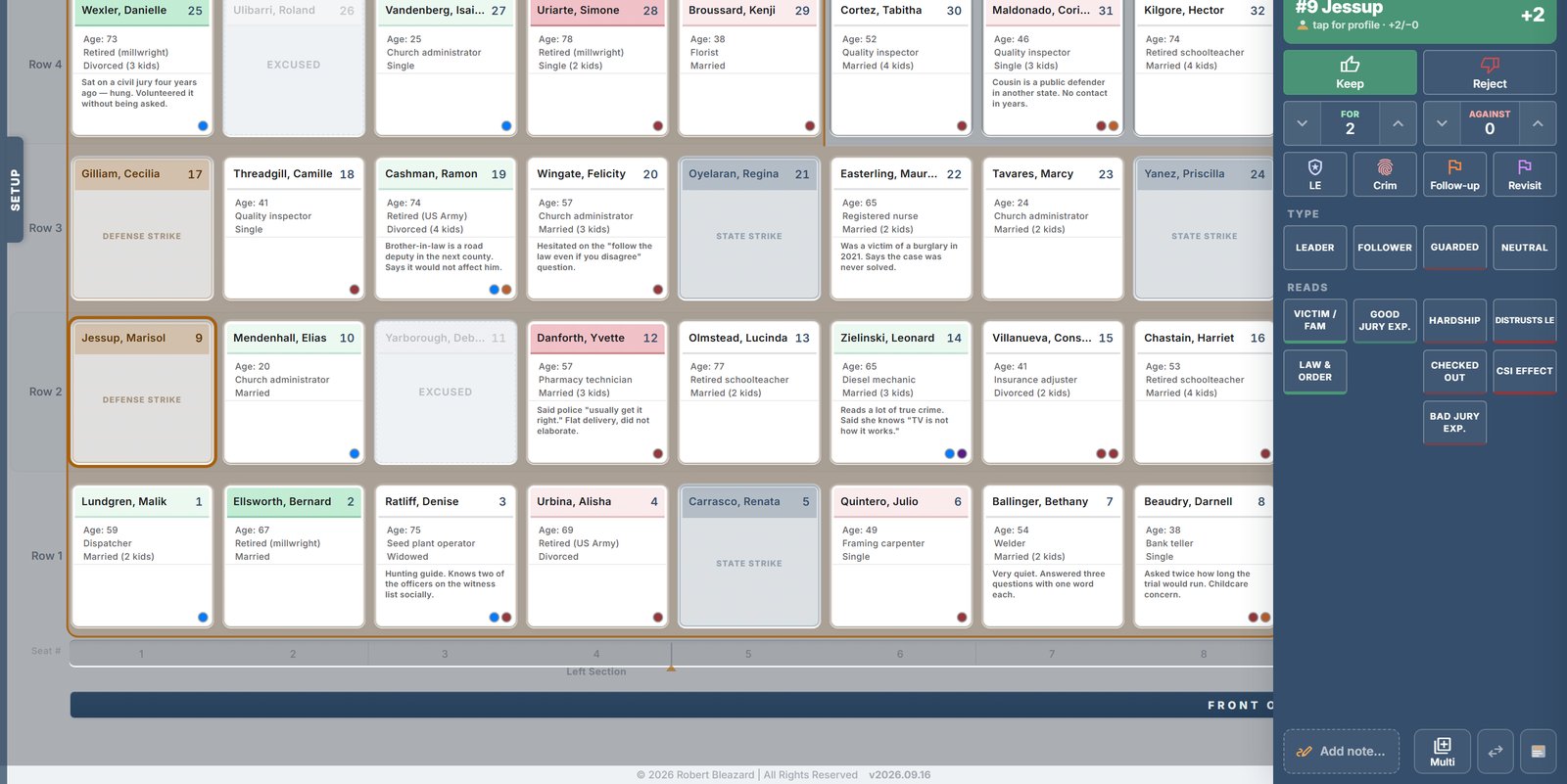
Jury selection app: You upload the juror list once. The software parses it into individual profiles. You rate jurors, flag concerns, and write notes — and so does your co-counsel, in the same workspace. By the morning of trial, every note and rating from every team member is in one place, visible to everyone.
What changes: Preparation goes from parallel and siloed to shared and cumulative. The team walks into court with collective intelligence, not individual notes.
The seating chart
Legal pad: You draw the jury box by hand. Twelve boxes, maybe six on top and six on bottom. You write the juror's name in the box. When they're struck, you cross it out and write the replacement. By the third round of strikes, the chart is a mess of crossed-out names and arrows.
Jury selection app: The seating chart mirrors your courtroom — correct number of seats, alternates in the right position, filling in the right direction. When a juror is struck, the replacement fills the seat automatically. The chart is always clean, always current, and visible to your whole team.
What changes: You stop redrawing the seating chart and start reading it. The cognitive overhead of maintaining the chart goes to zero, which frees your attention for the actual decisions.
Strike tracking
Legal pad: You keep a tally of strikes used — yours on one side, defense on the other. Cause challenges are a separate count. You do the subtraction in your head. If your co-counsel exercised a strike while you were questioning the panel, you might not know until the next break.
Jury selection app: Every strike — peremptory, cause, hardship — is recorded as it happens and visible to the entire team. Remaining counts update automatically. In struck-jury systems, pass rounds are tracked too. The count is always current, always shared, and never mental math.
What changes: You stop counting and start deciding. The mechanical bookkeeping that consumes attention during voir dire is handled by the software. Your focus stays on the jurors, not the arithmetic.
Team coordination
Legal pad: You pass notes. You whisper. You wait for a break to compare observations. If the analyst at the back of the courtroom sees something on a juror's social media, it reaches you when there's a pause — which might be after you've already made the strike decision.
Jury selection app: Everyone works the same panel in real time. A flag added by the paralegal appears on your screen immediately. A note from second chair shows up on the juror's profile as it's typed. When the judge gives you four minutes to decide your next strike, the information is already aggregated — no conference needed.
What changes: Information flow goes from sequential to simultaneous. The trial team operates as a team, not as individuals who sync up during breaks.
The record
Legal pad: When voir dire is over, the record is a stack of handwritten pages. If there's a Batson challenge or an appeal, you're reconstructing the strike sequence from notes that were written under pressure and may not be legible. The seating chart is buried under crossed-out names.
Jury selection app: Export a PDF with the final seating chart, the complete strike history, juror notes, ratings, and flags. The record is created as you go — not reconstructed after the fact. It's organized, searchable, and ready for the trial file.
What changes: The trial record goes from something you build after voir dire to something that builds itself during voir dire.
What doesn't change
Your judgment. Your instinct for which jurors will hurt your case and which ones will help it. Your ability to read body language, ask the right follow-up, and make the difficult strike decision when the math is tight. No software replaces that. The legal pad never did either.
What a jury selection app does is remove the mechanical overhead — the drawing, the counting, the note-passing, the reconstruction — so that your judgment has better information and fewer distractions. The decisions are still yours. The tool just makes sure you're making them with a clear picture.
JuryPanel is the jury selection app built for prosecutor's offices — digital seating charts, real-time strike tracking, team collaboration, and PDF export. $300 per attorney per year, office-wide.
Request a demo and decide for yourself.