What Batson requires
Batson v. Kentucky (1986) established the three-step framework that still governs. First, the objecting party makes a prima facie showing that a peremptory strike was exercised on the basis of race. Second, the burden shifts to the striking party to articulate a race-neutral reason. Third, the court decides whether purposeful discrimination has been shown.
The doctrine has grown since. J.E.B. v. Alabama (1994) extended it to gender. It applies to both sides of the aisle and in civil cases. But for a prosecutor in trial, the practical pressure point is always step two: the reason, articulated immediately, under scrutiny.
Step two is where preparation shows — or doesn't.
Why memory is the wrong tool
The challenge comes minutes or hours after the strike, sometimes after you've questioned forty jurors across a full morning. You are being asked to recall, specifically and credibly, why you struck juror 23 and not juror 31.
A reason reconstructed on the spot tends to come out generic: "demeanor," "body language," "didn't seem favorable." Generic reasons are where Batson litigation goes to die. Courts have grown skeptical of demeanor-based justifications precisely because they're unfalsifiable — Snyder v. Louisiana (2008) requires the trial court to actually evaluate the claimed demeanor, and an appellate court reviewing a cold record can't. If demeanor is the real reason, it needs a contemporaneous note describing what you saw, not a label attached after the objection.
The reason that holds up is specific, tied to something the juror said or disclosed, and written down before anyone objected.
Comparative juror analysis: the modern battleground
The center of gravity in Batson litigation has shifted from the struck juror to the seated ones. Miller-El v. Dretke (2005) and Flowers v. Mississippi (2019) confirmed what appellate courts now do routinely: compare the struck juror against similarly situated jurors who were not struck. If you struck a Black juror because she had a relative with a felony conviction, and seated a white juror with the same disclosure, the stated reason starts looking like pretext — regardless of what you intended.
This changes what an adequate record looks like. It is no longer enough to have a reason for the jurors you struck. You need notes on the whole panel, so that when the comparison comes — at trial or on appeal years later — the record shows you treated the same answer the same way regardless of who gave it.
Consistency is the defense. Notes on every juror are the proof of consistency.
What a defensible record looks like
A reason attached to every peremptory strike, at the moment you exercise it. Not at the recess. Not at the end of the day. The contemporaneous timestamp is itself evidence of credibility.
Reasons stated as facts, not conclusions. "Hesitated when asked whether she could convict on one witness's testimony" survives scrutiny. "Seemed weak on the State's case" does not. Record the answer, the disclosure, the hesitation — the thing you observed — and let the conclusion follow from it.
Notes on jurors you kept, not just jurors you struck. This is the comparative-analysis insurance. If your notes show you flagged the same concern on a seated juror and accepted it because of an offsetting factor, write down the offsetting factor.
A record that can be produced. Post-conviction litigation arrives years later, often on a colleague's desk. A strike sheet with marginalia in handwriting nobody can read is not a record. An exportable, organized account of the panel — who was struck, by whom, when, and why — is.
Habits that build
the record automatically
Document the reason in the same motion as the strike — one action, not two, or the second one gets skipped when voir dire is moving. Tie each flag to the juror's own words while they're fresh; verbatim fragments beat summaries. When a cause challenge fails and you follow with a peremptory, note that sequence — a denied cause challenge is itself a documented, race-neutral foundation. And at the end of selection, export everything to the trial file the same day, before the next case buries it.
None of this is about gaming the framework. The prosecutor with legitimate, juror-specific reasons has nothing to fear from Batson except a thin record. The record is the whole game.
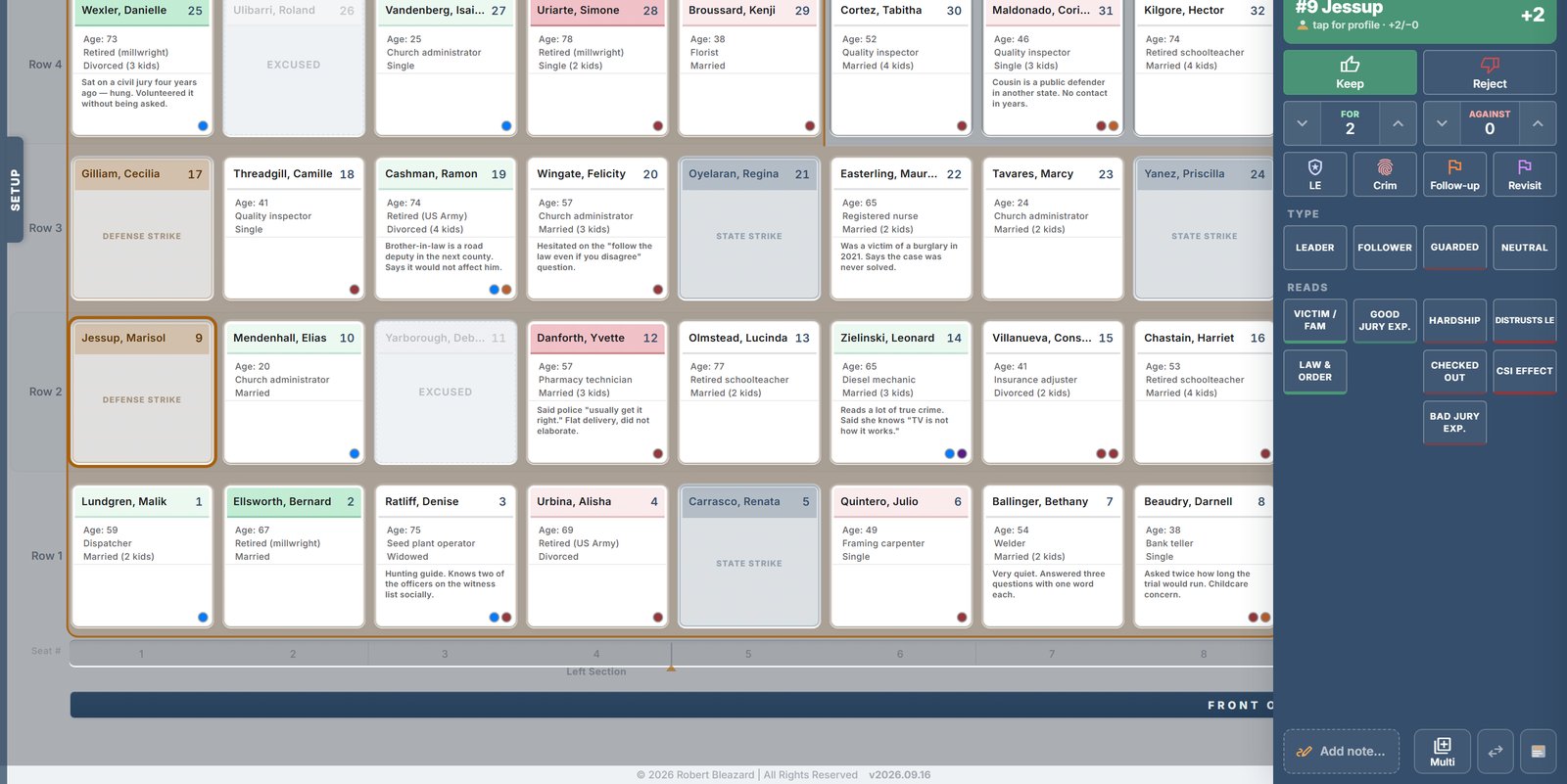
JuryPanel lets you attach a reason to each peremptory strike at the moment you exercise it, keeps your notes on every juror — struck and seated — in one place, and exports the complete panel record as a PDF for the trial file. When the challenge comes, the answer is already written.
Request a demo and see what the record looks like.